
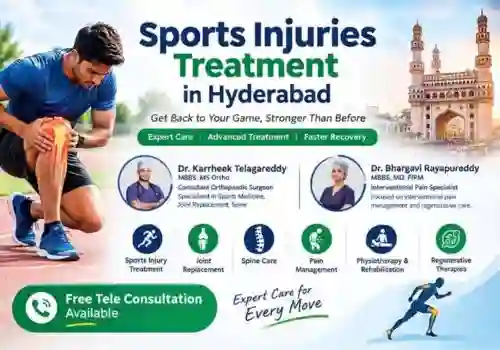
Sports injuries can happen to professional athletes, recreational players, gym enthusiasts and even people who are beginning a new exercise routine. A sudden twist, fall, collision, overuse or incorrect movement can affect the muscles, tendons, ligaments, cartilage, bones or joints.
At Healio RegenX Advanced Orthopaedics & Pain Management, sports injuries are approached by combining orthopaedic evaluation, sports medicine expertise, pain management and rehabilitation-focused care.
Dr. Kartheek Telagareddy, MBBS, MS – Orthopaedics, Consultant Orthopaedic Surgeon, specialises in Sports Medicine, Spine, Trauma and Joint Replacement. Dr. Bhargavi Rayapureddy, MBBS, MD, FIPM – Interventional Pain Specialist, focuses on interventional pain management and regenerative care.
The aim is not simply to reduce pain temporarily. The treatment process begins by identifying the cause of the injury, understanding its severity and functional impact, and then selecting an appropriate treatment plan based on the individual patient.
Free Tele Consultation Available
What Are Sports Injuries?
A sports injury is an injury that occurs during sports, exercise, training or physical activity. Sports injuries can affect almost any part of the body, but the most common problems involve the muscles, tendons, ligaments, bones, cartilage and joints.
Some injuries happen suddenly, such as an ankle sprain after landing awkwardly or an ACL injury following a twisting movement. Others develop gradually because of repetitive stress or overuse.
Sports injuries may range from a mild muscle strain to more significant injuries involving ligaments, cartilage, tendons or bones.
Common examples include:
- Ankle sprains
- Knee ligament injuries
- ACL and PCL injuries
- Meniscus tears
- Shoulder dislocations
- Rotator cuff injuries
- Muscle strains
- Tendon injuries
- Tennis elbow
- Golfer’s elbow
- Cartilage injuries
- Stress fractures
- Hip and groin injuries
- Back and neck injuries
- Sports-related joint pain
The appropriate treatment depends on the exact structure involved, the severity of the injury, the patient’s age and activity level, and the goals of recovery.
What Causes Sports Injuries?
Sports injuries can result from a single traumatic event or develop progressively through repeated stress.
Common causes include:
Sudden trauma:
Falls, collisions, tackles, direct blows or awkward landings can damage joints, muscles, ligaments and bones.
Overuse:
Repeated movements without adequate recovery can place excessive stress on muscles, tendons and joints.
Poor technique:
Incorrect movement patterns during running, lifting, jumping or throwing can increase mechanical stress.
Inadequate warm-up:
Starting intense activity without appropriate preparation may increase the risk of muscle and joint problems.
Rapid increase in training:
Suddenly increasing exercise intensity, distance, frequency or weight can overload tissues.
Previous injury:
An incompletely rehabilitated injury may affect movement and increase the risk of another injury.
Inappropriate equipment:
Improper footwear or unsuitable sports equipment can contribute to certain injuries.
Muscle weakness or imbalance:
Reduced strength, flexibility or coordination can affect movement mechanics.
Common Sports Injuries
1. Knee Sports Injuries
The knee is particularly vulnerable during running, jumping, pivoting and contact sports.
Common knee sports injuries include:
- ACL injuries
- PCL injuries
- MCL and LCL injuries
- Meniscus tears
- Patellar tendon injuries
- Cartilage injuries
- Patellofemoral pain
- Knee sprains
- Sports-related knee pain
An ACL injury commonly occurs during sudden changes in direction, landing or pivoting. Treatment depends on factors such as the injury pattern, activity requirements, associated injuries and clinical findings. The American Academy of Orthopaedic Surgeons maintains a clinical practice guideline for ACL injuries.
Meniscus injuries may occur after twisting or rotational trauma. Treatment depends on factors such as the tear pattern, location, symptoms and associated injuries. Current AAOS guidance specifically addresses acute isolated meniscal pathology.
2. Shoulder Sports Injuries
Shoulder injuries are common in sports involving throwing, overhead movement, contact or repetitive arm activity.
Possible conditions include:
- Shoulder dislocation
- Rotator cuff injuries
- Labral injuries
- Shoulder instability
- Tendon injuries
- Shoulder impingement-related symptoms
- AC joint injuries
- Shoulder fractures
Athletes involved in cricket, swimming, tennis, badminton, volleyball, throwing sports and gym-based activities may experience shoulder problems.
Persistent pain, recurrent instability, weakness or loss of shoulder movement should be assessed rather than repeatedly playing through the symptoms.
3. Ankle Sports Injuries
Ankle sprains are common when the foot rolls or twists unexpectedly.
Symptoms may include:
- Pain
- Swelling
- Bruising
- Difficulty walking
- Reduced ankle movement
- Feeling of instability
Not every ankle injury is identical. A significant sprain, recurrent instability or suspected fracture may require further assessment and imaging.
4. Muscle and Tendon Injuries
Muscle strains and tendon injuries can occur because of sudden acceleration, repetitive activity, excessive loading or inadequate recovery.
Common examples include:
- Hamstring strain
- Calf strain
- Groin injury
- Achilles tendon problems
- Patellar tendon injuries
- Rotator cuff tendon injuries
- Tennis elbow
- Golfer’s elbow
The treatment approach depends on the location and severity of the injury.
5. Cartilage Injuries
Cartilage helps provide smooth movement within joints. Sports-related trauma can sometimes damage the cartilage or the underlying bone.
Cartilage problems may cause:
- Joint pain
- Swelling
- Stiffness
- Clicking or catching
- Reduced activity tolerance
A detailed assessment is important because cartilage injury may occur alongside ligament, meniscus or other joint injuries.
6. Hip, Groin and Sports-Related Back Pain
Running, jumping, twisting and repetitive training can contribute to hip, groin and lower-back symptoms.
Possible causes include:
- Muscle strain
- Tendon problems
- Hip joint conditions
- Groin injuries
- Stress-related bone injuries
- Lumbar spine problems
- Disc-related conditions
Because pain in these areas can have multiple causes, diagnosis should be based on clinical assessment rather than assuming every sports-related pain is a simple muscle strain.
Sports Injury Symptoms: When Should You See a Doctor?
A sports injury should be medically assessed when symptoms are severe, persistent, recurrent or affecting normal movement.
Seek professional evaluation if you experience:
- Significant swelling
- Severe or persistent pain
- Difficulty putting weight on a limb
- Reduced range of movement
- Joint instability
- Recurrent injury
- Significant bruising
- Weakness
- Numbness or tingling
- A popping sensation followed by pain or swelling
- Joint locking or catching
- Visible deformity
- Difficulty returning to normal activity
Emergency assessment may be appropriate for serious trauma, suspected fracture or dislocation, major deformity, loss of circulation or sensation, severe neurological symptoms or other concerning symptoms.
How Are Sports Injuries Diagnosed?
Accurate diagnosis is one of the most important parts of sports injury treatment.
At Healio RegenX, the evaluation may include:
1. Medical History
The doctor may ask:
- How did the injury happen?
- Was there a twisting, impact or fall?
- When did the pain begin?
- Did swelling develop immediately?
- Have you experienced this problem before?
- What sports or activities do you participate in?
- What movements make the symptoms worse?
- Have you already tried any treatment?
2. Physical Examination
The examination may assess:
- Joint movement
- Muscle strength
- Stability
- Tenderness
- Swelling
- Gait
- Functional movement
- Neurological findings where relevant
3. Imaging
Depending on the suspected condition, investigations may include:
- X-rays
- Ultrasound
- MRI
- CT scans
Not every sports injury requires advanced imaging. The appropriate investigation depends on the clinical findings and suspected diagnosis.
Sports Injuries Treatment in Hyderabad
There is no single treatment that is appropriate for every sports injury.
At Healio RegenX, treatment is selected according to the diagnosis, severity of injury, symptoms, activity level, previous treatment and recovery goals.
Treatment may include:
Conservative Treatment
Mild or moderate injuries may sometimes improve with activity modification, appropriate rest, rehabilitation and other non-surgical measures.
The objective is to protect the injured structure while gradually restoring movement, strength and function.
Physiotherapy and Rehabilitation
Rehabilitation plays an important role in many sports injuries.
Depending on the injury, rehabilitation may focus on:
- Range of motion
- Muscle strengthening
- Flexibility
- Balance
- Coordination
- Joint stability
- Movement mechanics
- Gradual return to sport
A structured rehabilitation program can help patients progress from basic movement to sport-specific activity.
Pain Management
Pain can sometimes continue even after the initial injury has occurred.
This is where orthopaedic and pain-management expertise can work together.
Dr. Bhargavi Rayapureddy, MBBS, MD, FIPM – Interventional Pain Specialist, focuses on interventional pain management and regenerative care. Depending on the diagnosis, selected patients may be considered for appropriate pain-management procedures after clinical evaluation.
The objective is to address pain as part of a broader treatment plan rather than treating pain in isolation.
Injection-Based Treatments
Certain injection-based treatments may be considered for selected musculoskeletal conditions.
Depending on the diagnosis, treatment options may include appropriately selected injections or regenerative approaches.
For example, PRP uses components derived from a patient’s own blood. However, suitability and expected outcomes vary by condition, and regenerative treatments should not be presented as a universal solution for every sports injury.
At Healio RegenX, the decision to consider an injection-based treatment is made after assessment of the individual condition.
Minimally Invasive and Surgical Treatment
Some injuries involve structural damage that may require surgical treatment.
Depending on the injury, procedures may include:
- Arthroscopic ligament procedures
- Meniscus procedures
- Shoulder arthroscopy
- Rotator cuff procedures
- Treatment of recurrent shoulder instability
- Cartilage-related procedures
- Fracture treatment
- Other orthopaedic procedures
Surgery is not automatically required simply because an injury appears on an MRI. The clinical picture, symptoms, functional limitations, injury characteristics and patient’s goals all matter.
Do All Sports Injuries Need Surgery?
No.
Many sports injuries can be managed without surgery, depending on the diagnosis and severity.
Non-surgical treatment may include:
- Activity modification
- Rehabilitation
- Physiotherapy
- Strengthening
- Mobility exercises
- Pain management
- Selected injection-based treatments
- Gradual return-to-sport programs
However, some injuries may require surgery, particularly when there is significant structural damage, persistent instability, mechanical symptoms, certain fractures, or failure of appropriate non-operative treatment.
The decision should be made after an individual clinical assessment.
What Is the RICE Method?
For some acute minor sprains and strains, early care may include the traditional RICE approach:
- R – Rest: Reduce activities that aggravate the injury.
- I – Ice: A cold pack may be used for short periods to help with pain and swelling.
- C – Compression: Appropriate compression may help control swelling in selected injuries.
- E – Elevation: Elevating the injured limb may help reduce swelling.
RICE should not be considered a complete treatment plan for every sports injury. Significant injuries, severe pain, deformity, inability to bear weight or persistent symptoms require medical assessment.
Sports Injury Rehabilitation and Return to Sport
Returning to sport too quickly can increase the risk of reinjury.
A safe return-to-activity plan may consider:
- Pain and swelling control
- Restoration of joint movement
- Recovery of muscle strength
- Balance and coordination
- Sport-specific movement
- Functional testing where appropriate
- Gradual increase in training load
- Monitoring for recurrence of symptoms
The timeline varies considerably between injuries.
An athlete recovering from a mild ankle sprain will have a different rehabilitation pathway from someone recovering from ACL reconstruction or a significant shoulder injury.
The goal should be progressive recovery rather than simply returning to the playing field as quickly as possible.
How Can Sports Injuries Be Prevented?
Although not every sports injury can be prevented, several habits may reduce risk.
Warm up properly
Prepare the body before intense exercise with suitable dynamic movement and sport-specific preparation.
Increase training gradually
Avoid sudden increases in exercise intensity, distance, duration or resistance.
Strengthen the body
Strength training can support joint stability, movement control and physical capacity.
Work on technique
Correct sports technique can help reduce unnecessary loading on certain body structures.
Allow recovery
Adequate rest and recovery are important when training regularly.
Use appropriate equipment
Proper footwear and suitable protective equipment can be important depending on the sport.
Do not ignore recurring pain
Repeated pain may indicate an underlying problem that requires assessment.
Sports Injuries Treatment at Healio RegenX
Healio RegenX brings orthopaedic and pain-management expertise together in one place.
The current Healio RegenX care model emphasises understanding the cause of symptoms before selecting treatment and combines orthopaedic care with personalised pain-management and rehabilitation pathways.
Dr. Kartheek Telagareddy
MBBS, MS – Orthopaedics, Consultant Orthopaedic Surgeon
Specialised in Sports Medicine, Spine, Trauma & Joint Replacement
Dr. Kartheek Telagareddy provides orthopaedic evaluation and treatment for sports-related musculoskeletal problems, including injuries involving the knee, shoulder, spine and other joints.
Dr. Bhargavi Rayapureddy
MBBS, MD, FIPM – Interventional Pain Specialist
Dr. Bhargavi Rayapureddy focuses on interventional pain management and regenerative care for selected musculoskeletal conditions.
Having both areas of expertise available at one centre can be useful when a patient’s condition involves both a structural orthopaedic problem and significant or persistent pain.
Why Choose an Integrated Orthopaedic and Pain Management Approach?
Sports injuries do not always fit into a single category.
For example, a patient may have:
- A structural ligament injury with significant pain
- A shoulder tendon problem with persistent symptoms
- Knee injury followed by ongoing pain
- A sports injury requiring rehabilitation and pain control
- A chronic problem following an old injury
An integrated approach allows the treatment plan to consider both the underlying musculoskeletal problem and the patient’s pain and functional limitations.
At Healio RegenX, the approach may involve:
Assessment → Diagnosis → Treatment Planning → Pain Management → Rehabilitation → Follow-up
The exact pathway depends on the individual diagnosis.
When Should You Consult a Sports Injury Specialist in Hyderabad?
Consider an evaluation if:
- Your pain continues after a sports injury
- You cannot return to your usual activity
- Your knee or shoulder feels unstable
- You experience repeated ankle sprains
- You hear a pop followed by swelling or pain
- You have difficulty putting weight on the affected limb
- Your joint locks or catches
- Your pain keeps returning during training
- You have reduced strength or movement
- An old sports injury is affecting your current performance
Early assessment can help identify the injury and clarify available treatment options.
Frequently Asked Questions About Sports Injuries
Q : What is the most common sports injury?
Ans : Sprains and strains are among the commonly encountered sports injuries. However, the type of injury varies according to the sport, activity, age, training level and mechanism of injury.
Q : What are the most common sports injuries affecting the knee?
Ans : Common knee sports injuries include ACL injuries, PCL injuries, MCL or LCL injuries, meniscus tears, cartilage injuries, patellar tendon problems and other overuse-related conditions.
Q : What are the common shoulder sports injuries?
Ans : Shoulder dislocation, instability, rotator cuff injuries, labral problems, tendon injuries and AC joint injuries can occur in different sports and activities.
Q : Can sports injuries be treated without surgery?
Ans : Yes. Many sports injuries can initially be managed with appropriate non-surgical care such as activity modification, rehabilitation, physiotherapy and pain management. Some structural injuries may require surgery depending on the diagnosis and individual circumstances.
Q : How long does it take to recover from a sports injury?
Ans : Recovery time varies significantly. A minor strain may improve within a relatively short period, while ligament injuries, fractures and injuries requiring surgery may require a much longer rehabilitation period.
Q : Is MRI necessary for every sports injury?
Ans : No. MRI is not required for every sports injury. The need for imaging depends on the medical history, physical examination and suspected diagnosis.
Q : Can I continue playing with sports injury pain?
Ans : Continuing to play through significant or persistent pain may aggravate some injuries. If pain, swelling, instability or reduced function persists, it is appropriate to have the injury assessed.
Q : Can PRP help sports injuries?
Ans : PRP may be considered for selected musculoskeletal conditions, but it is not appropriate for every sports injury and results can vary. A specialist should determine whether it is suitable for the specific diagnosis.
Q : When is surgery considered for a sports injury?
Ans : Surgery may be considered when there is significant structural damage, persistent instability, certain fractures or other conditions where surgical treatment is clinically appropriate. The decision depends on the injury, symptoms, activity requirements and response to other treatments.
Q : Who treats sports injuries at Healio RegenX?
Ans : Sports-related orthopaedic conditions can be evaluated by Dr. Kartheek Telagareddy, MBBS, MS – Orthopaedics, Consultant Orthopaedic Surgeon, specialised in Sports Medicine, Spine, Trauma & Joint Replacement. Pain-management needs can also be evaluated by Dr. Bhargavi Rayapureddy, MBBS, MD, FIPM – Interventional Pain Specialist.
Q : Is teleconsultation available for sports injuries?
Ans : Yes. Free Tele Consultation is available at Healio RegenX. A teleconsultation can help you discuss your symptoms, previous reports and the next appropriate step. Some conditions will still require an in-person physical examination or imaging.
Sports Injuries Treatment in Hyderabad – Take the Next Step
A sports injury does not always mean that you need surgery, and persistent pain should not simply be ignored.
The first step is understanding what is injured, how severe it is and what treatment options are appropriate for your situation.
At Healio RegenX Advanced Orthopaedics & Pain Management, orthopaedic and interventional pain expertise are available together to support diagnosis, treatment planning, pain management and rehabilitation.
Consult Dr. Kartheek Telagareddy and Dr. Bhargavi Rayapureddy for personalised evaluation of sports-related injuries.
Free Tele Consultation Available
Call / WhatsApp: 8181945945
Healio RegenX – Advanced Orthopaedics & Pain Management
Banjara Hills | Bandlaguda Jagir / Suncity, Hyderabad
Book an Appointment and discuss your sports injury with a specialist.
